
Not the Soft Part. The Whole Job.
What a very busy toddler, two paradoxes, and a man in a cardigan taught me about why relationship comes first.

I was, by every account my mother ever gave, a very busy toddler. Into everything. Always on the move, out the door before anyone noticed the door was open. And yet in February of 1968, at 14 months old, with my brother Cliff barely past two years old and my mother newly pregnant with the brother who'd arrive that coming November, I would sit — actually sit, actually still — in front of a small black-and-white television for a man in a cardigan who spoke to me like I was already a person worth talking to.
Think about what that year actually held for her. Three children under three by November 1968, in a house that surely never stopped moving, and somewhere in the middle of all of it, a half hour most afternoons where the noise settled and something steady held the room instead of her having to. I don't know if my mother ever thought of Mister Rogers as a lifeline. I doubt she had the language for it, or the time to reach for the language even if she did. But I know what a lifeline looks like now, thirty years as a parent myself and thirty years into this work, and I recognize one when I see it in hindsight.
She would have two more of us after that, in 1973 and in 1977. Mister Rogers ran the whole time — decades of afternoons, all the way until the last new episode aired in the summer of 2001. I don't remember any of it directly. What I have instead is the shape it left behind: I still reach for Daniel Tiger's Neighborhood, the official animated successor to that same show, in my own private SLP sessions today. I recommend it constantly to the early intervention families I work with, toddlers who are working just as hard as I once was to hold a big feeling in a small body. Same puppet-hearted lineage. Same premise, sixty years later. It still works.
The Grain You Don't Notice
There's an old philosophical puzzle about a heap of sand sitting on a table. Pull one grain away and it's still a heap — obviously. Pull another. Still a heap. Keep going, one grain at a time, patiently, and eventually you're left holding a single grain that is, just as obviously, not a heap. Nobody can point to the exact moment the heap stopped being a heap. It just did, one unremarkable subtraction at a time, and by the time you notice, the thing you had is simply gone.
I hear a version of this puzzle in my office almost every week, though nobody uses that language for it. A parent tells me, a little apologetically, that they missed story hour at the library again this month. That the tablet ran long on a hard day. That the bedtime books got skipped because the day genuinely, honestly ran out before the day did. And every single time, they're right that the one missed moment changed nothing. One grain doesn't make or break a heap.
But a thousand of those grains, stacked quietly over a year without anyone counting them, build the actual architecture of a childhood — for better and for worse. That's not a scare tactic. It's just how compounding works, in either direction. It's also the entire logic underneath the "try one thing and observe for 7 to 14 days" framework I coach almost every family through. I never ask a parent to fix the whole heap in one sitting, because the whole heap was never the unit that mattered. The grain in your hand today is the unit that matters. Pay attention to that one, and trust that attention, repeated, becomes the shape of something.
Faith and the Brutal Facts
There's another paradox I return to more than any other, and it comes from a much harder place than a kitchen table. Admiral James Stockdale spent eight brutal years as a prisoner of war, tortured repeatedly, with no known release date and no rights to speak of. When he was finally asked, years later, who among his fellow prisoners hadn't made it out, his answer came immediately: the optimists. The ones who insisted they'd be home by a specific holiday. When that holiday came and went, they picked a new one. And when that one came and went too, something in them broke that never fully mended.
Stockdale survived by holding two things at once instead of one. An unshakeable faith that he would eventually prevail — the kind of faith he said he could never afford to lose — paired with a brutal, unflinching willingness to look directly at exactly how hard the present moment actually was. Not instead of the faith. Alongside it.
Now, I want to be careful here, because nothing about raising a child is close to what Stockdale survived. But strip his paradox down to its bones and you find the entire architecture of wondering before you worry, sized for an ordinary Tuesday instead of a POW camp.
Think about how many stages a child moves through that could each, on their own, convince a tired parent of the worst. The sweet, maddening pre-verbal twos, when a child is clearly trying to tell you I want that or something hurts and simply doesn't have the words yet. The dramatic fours, when the emotional weather can turn on a dime even as they're quietly mastering their shapes, their colors, the pre-academic skills nobody's giving them credit for in the moment. Then the tweens. The teens. The uncertain, wobbling launch into young adulthood. Every single one of those phases can leave a parent tipping too far toward blind optimism — this is just a stage, it'll pass on its own — or too far toward the brutal facts, convinced the hard thing in front of them is now permanent.
Thomas Oppong, writing about this same paradox, put words to the place in between: resilience lives in the middle. Not pure optimism, which leads to denial. Not pure realism, which leads to despair. The courage to look straight at the hard phase — the tantrum, the silence, the door slammed a little too hard — without letting it convince you of a "final outcome" that hasn't happened yet. Because it hasn't. Kids are never what they are forever. They are never, at four or fourteen, presenting you with the finished version of themselves. Humans keep growing, learning, and changing for the whole span of a life — which is either the most obvious sentence in this entire post or the one worth taping to your refrigerator, depending on the week you're having.
I gave my own mother a real run for her money — an extremely energetic, occasionally reckless kid who did not make her job easy. She held on anyway, through whatever the brutal facts of that particular Tuesday were. And now, decades later, she can see plainly that none of it was ever my final outcome.

The Whole Job
Here's what I've noticed, though, after enough years of watching parents try to apply frameworks like these: none of it — not the grain, not the brutal facts, not any well-built paradox — moves a child forward on its own. It all depends on something underneath it that most of us treat as optional.
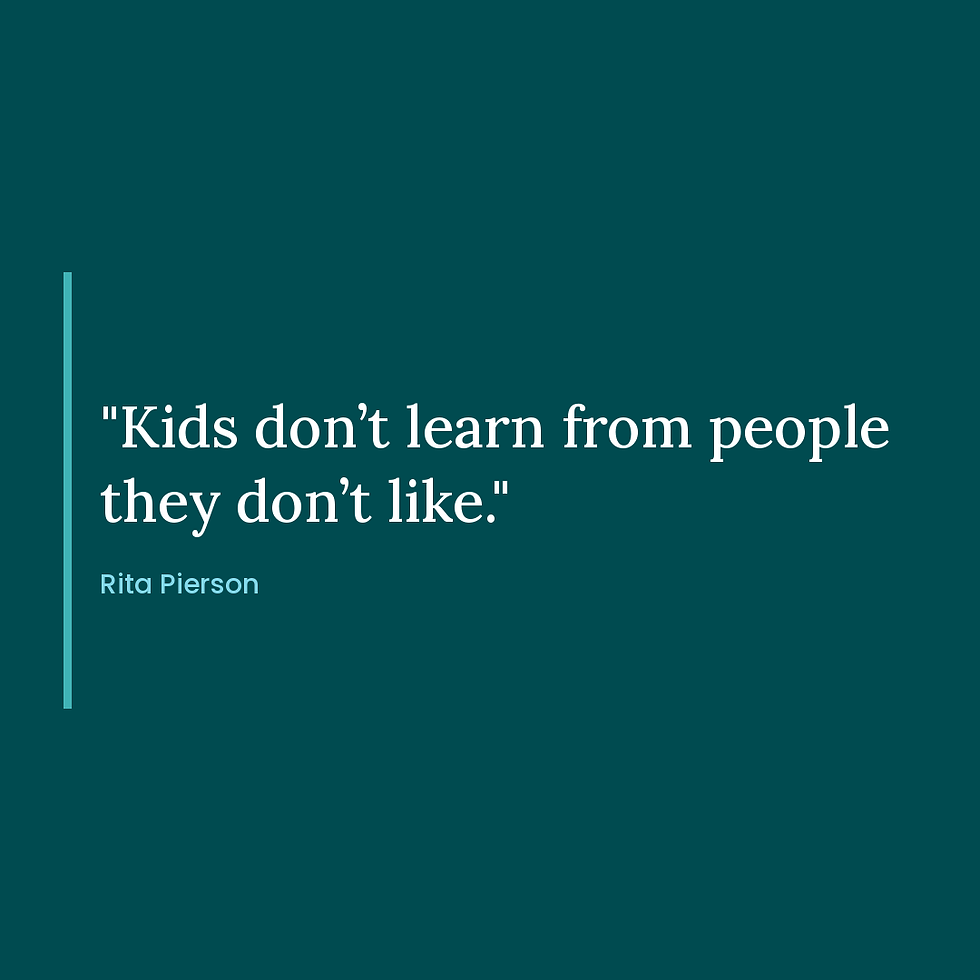
Rita Pierson, who spent forty years in classrooms, said it plainer than any framework I've ever built: kids don't learn from people they don't like. She wasn't being sentimental. She meant it structurally, the way you'd describe a load-bearing wall. Relationship isn't the warm-up act before the real teaching starts. It isn't the nice-to-have you get to once the curriculum is covered. It is the curriculum's delivery system — the entire reason a child leans toward a grown-up instead of away from one.
Fred Rogers understood the other half of that same equation, and he understood it from a completely different direction. Actor LeVar Burton once recalled a conversation with Rogers about children, in which Rogers told him plainly: "Don't be afraid to be your authentic self. That's who they need." Pierson names that relationship comes first. Rogers names what makes a relationship sturdy enough to actually carry that weight — not a performed version of warmth, not competence recited on schedule, but the real, unguarded person underneath it. A child can tell the difference between a grown-up saying the right words and a grown-up who is genuinely, unguardedly glad they're in the room. Only one of those relationships teaches anything at all.
From a Small Screen to a Small Moon
So here's the straight line, as best I can draw it, from 1968 to now. A very busy toddler sat still for a man on a screen because he was real with her, and because he clearly liked having her there. Decades later, I built a career putting that same show — its animated descendant, anyway — back in front of other toddlers, for the exact same reason it worked on me the first time. And now, in 2026, that same conviction has become one of the threads woven directly into LUMA: that a child needs to feel liked before anything else can land, and that the grown-up in the room has to be real for the liking to mean anything.
I've started calling the voices behind threads like that one LUMAnaries, and I want to be precise about what the word actually holds, because it's not a one-time credit line. It's a living constellation, and it has three kinds of stars in it. There are the famous voices whose ideas have simply stood the test of time — Fred Rogers among them. There are the clinicians and specialists who bring their professional lens to early childhood, the way any good colleague sharpens your thinking over years of shared work. And there are the beta testers, the parents, grandparents, special aunts, teachers and others who've spent months in honest, sometimes uncomfortable conversation with LUMA, who then passed along to me when LUMA got it wrong and who have shaped her the way any of us get shaped by people willing to tell us the truth. Every last one has made LUMA wiser and all of them are part of her guiding light that she will offer to countless people who have a child in their life.
None of that makes LUMA human, and I want to be careful never to suggest it does — she isn't, and she never will be. But those voices, all three kinds, are part of what shapes her knowledge and her warmth going forward, the way a good mentor shapes a person without becoming one.
LUMA's on Instagram now — come say hi: @raisinghumansai.
About the Author
Cindi Z. Stevens Copeland, MA, CCC-SLP, is a speech-language pathologist with more than 30 years of experience working with children and families. She is the founder of Right Track Parenting and the creator of the Investigative Parenting methodology — a research-backed framework that guides parents to wonder before they worry, imagine before they interpret, and create before they catastrophize. Cindi holds a Certificate in the Foundations of Positive Psychology from the University of Pennsylvania and is a certified Parent Coach through the Parent Coaching Institute. She runs a direct-pay private practice in Northern Virginia and is the creator of LUMA, an AI-powered companion for anyone raising or caring for a child, available at RaisingHumans.ai (coming soon!). Learn more about Cindi and Right Track Parenting at righttrackparenting.com.
© 2026 Right Track Parenting. All rights reserved. No part of this blog may be reproduced or distributed without written permission.


Comments