
One Caring Adult
She was seen once a month. They called three hours "more."

What Money Can Buy
There's a piece that ran in the Wall Street Journal not long ago about parents who hire not one nanny but a team of them (a night nanny, a weekend nanny, sometimes a "family executive assistant" whose whole job is logistics). They called these parents "CEO parents," and I read it without judgment, genuinely. If you can build your child a village out of hired hands, build it. Every kid needs more caring adults, not fewer, and I'm not interested in shaming anyone for having found a way to afford that.
But it named something for me, the way a good detail does. It named the range. On one end: a rotating team of specialists, on call, funded. On the other end, in my caseload, in Northern Virginia, in one of the wealthiest counties in the country, where plenty of families could afford exactly that kind of team: a little girl I'll call Nora, whose family could afford exactly one hour of the help she needed. Once a month.
Nora
Nora had a severe communication delay (the kind where a two-year-old should be stringing early words together and instead points, grunts, pulls your hand toward what she wants because pointing hasn't landed yet either). Her Infant-Toddler Connection (ITC) Fairfax-Falls Church individual family service plan called for four sessions a month. That's the number a team of specialists sat in a room and decided, based on her actual needs at the initial assessment, not her family's calendar.
Her parents both worked full days, one of them two jobs, and there was no version of the schedule that made four visits possible. So it became one. Once a month, I'd see her for a session, hand her mother whatever strategies I could compress into forty-five minutes, and leave knowing three weeks would pass before the next one.
Here's the part that still sits wrong in my chest. When it came time for the Fairfax County Public Schools Early Education Program to assess her eligibility for their program, the team looked at what she'd actually been getting (one, 60-minute session per month) and proposed raising it to three hours of resource services per month in their program. They called it an increase. On paper, it was; three is more than one. But nobody in that room measured it against the four she needed in the first place. They measured it against the one she'd already been forced down to. A reduction got quietly renamed progress, because everyone had stopped looking at the original number.
I think about this family more than I think about almost anything else from that time in my whole career of serving families with babies and toddlers.

The Window That Doesn't Wait
About 80 percent of a child's brain growth happens before age three. Not "a lot." Eighty percent, in the same thirty-six months where Nora's family was doing math about gas money and shift schedules, not about neural architecture. Nobody chooses that. No parent sits at a kitchen table and decides their toddler's language development matters less than their electric bill. They decide what they can, with what they have, and the window closes on its own schedule regardless.
That's the ache underneath this whole post. It isn't that some families have more. It's that the exact years when a child's brain is doing its most urgent, most permanent work are the same years when so many families are making care decisions from scarcity instead of from what their child actually needs.

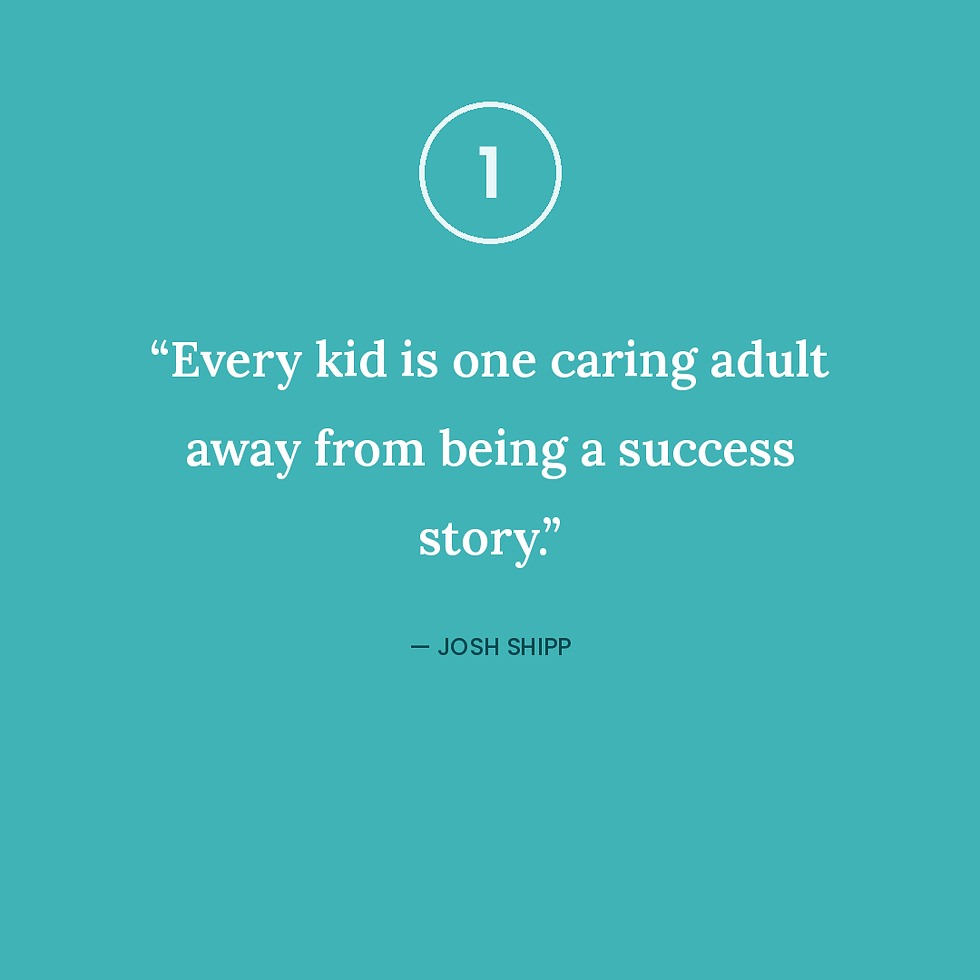
Josh Shipp puts it in nine words: every kid is one caring adult away from being a success story. Harvard's Center on the Developing Child says almost the same thing in the language of research: every child who ends up doing well has had at least one stable, committed relationship with a supportive adult. Not a team. Not a full village, though a village helps. One relationship, stable enough to lean on.
That's a low bar and a high bar at the same time. Low, because it doesn't require a CEO parent's budget. High, because for a family working multiple jobs and getting one session a month, even "one caring adult, consistently available" can be out of reach.
What's Already in the House
Something has been happening quietly in family life that I think matters here, whether we've named it yet or not. Eighty-one percent of parents are already using AI for something related to parenting, and most of us didn't sit down and decide to trust a machine with our kids. It crept in the way most things do now: a question typed in at 11pm, an answer that helped, another question the next week. Axios described it as an "always-on presence that remembers, anticipates, and increasingly acts like a member of the family," and reading that line, I recognized something in my own house before I recognized it in anyone else's.
I built LUMA because I kept thinking about Nora's family, and every family like hers, sitting at that kitchen table doing math nobody should have to do alone.
Give-One
Here's where I tell you the truth about where this actually is, because I don't want to write you a polished version of a promise. Right now, I have one paying subscriber to LUMA. It's me.
I'm not saying that to be self-deprecating. I'm saying it because Give-One only means something if I tell you honestly what stage it's in. The idea is simple: for every subscription, one gets given away, free, to a family who couldn't otherwise afford it. This week, that's not a plan on a slide. It's three phone calls and emails I'm actually making.
I'm following up with the director at ITC Fairfax-Falls Church about donating subscriptions through the early intervention referral list I'm already part of. I'm reaching out to Fairfax Diapers, a local nonprofit, about taping a Give-One code to every box of diapers they hand a family. And I'm working out how to get a code into the hands of new parents at local hospital maternity wards, tucked inside something small (a stuffed crescent moon, tied back to LUMA's own moon mark) so it arrives less like a pitch and more like a gift.

This isn't a database answer. It's thirty years of one clinician's judgment, offered to a family who couldn't otherwise afford it.

I don't know yet how many of these calls will land. Maybe the diaper bank says yes and the hospital says not this year. Maybe the ITC director already has three other ideas better than mine. I'll tell you as it unfolds, the real version, not the version where it was always going to work.
One Caring Adult
Nora's story isn't really about Nora. It's about every family doing the same quiet math, deciding what they can afford this month instead of what their child actually needs, in the exact years that decision matters most permanently. I can't fix the funding. I can't sit in that Individual Education Plan (IEP) meeting with Fairfax Country Early Education Program staff and argue the number back up to four. But I can make sure that somewhere, a Give-One code is taped to a box of diapers, or handed to a new mother in a hospital room, and that one caring adult, in whatever form she can reach a family, is one thing money didn't have to decide.
If you were the one caring adult in a child's life this week, who was it for, and did you know at the time that's what you were?
About the Author
Cindi Z. Stevens Copeland, MA, CCC-SLP, is a speech-language pathologist with more than 30 years of experience working with children and families. She is the founder of Right Track Parenting and the creator of the Investigative Parenting methodology, a research-backed framework that guides parents to wonder before they worry, imagine before they interpret, and create before they catastrophize. Cindi holds a Certificate in the Foundations of Positive Psychology from the University of Pennsylvania and is a certified Parent Coach through the Parent Coaching Institute. She runs a direct-pay private practice in Northern Virginia and is the creator of LUMA, an AI-powered companion for anyone raising or caring for a child available at RaisingHumans.ai. Learn more about Cindi and Right Track Parenting at righttrackparenting.com.
© 2026 Right Track Parenting. All rights reserved. No part of this blog may be reproduced or distributed without written permission.


Comments