
The Cracked Bowl: Where It Broke, There Is Gold
- righttrackparentin
- Feb 25
- 9 min read
Updated: Mar 3

On the morning of February 18th, before I knew anything about what I would find at the end of my drive, I left Virginia at 5am headed to Cleveland Clinic. My dad had been hospitalized. The details were still unclear. And somewhere in those early, dark miles on the I-70 en route to the Pennsylvania Turnpike, my brain did something I didn't consciously choose: it reached for grief.
I turned on Anderson Cooper's podcast, All There Is. I had listened to it in the first year after losing my husband Chip to pancreatic cancer, then set it aside. I picked it up again that morning without fully understanding why. Now I do. My brain was preparing. If this is the worst, it was quietly saying, I will be ready.
It wasn't the worst. My dad came home five days later, his medication adjusted, his wit fully intact, engaging every staff member he could make eye contact with on his way out. But what happened between that 5am departure and the moment he walked back through his front door in Akron gave me more to sit with than I bargained for.
Some of it was beautiful. Some of it was hard. All of it was gold.
The Morning My Mother Told Me the Truth

The morning after I arrived in Ohio, I drove my mom to the hospital. It was a long drive — close to an hour. She started talking almost immediately about the topics she always talks about: the quilt she needed to finish, her quilt guild members, how she can't reach the coffee cups anymore because she's lost height in old age, the plan for dinner after the day's hospital visit for her, me and my brother Peter who had come from Vermont to see my dad as well.
Near the end of our journey, she suddenly started on a topic I was not expecting.
She told me that for the first twenty years of their marriage, my dad had been verbally abusive toward her. That he called her "fat." That he said he was embarrassed to take her places because of her weight. That he told her the house she was supposed to be keeping was "a pig sty." That he called her "stupid." That he called her "dumb."
I said the only thing I could think to say: "I'm sure we all heard the way he treated you too."
Maybe, she said.
She went on. In 1987, when my parents moved to Florida but my dad continued traveling back to Ohio twice a month to run the family furniture store, something shifted in my mom. She found herself. She became capable and independent in ways she hadn't known she could be, because she had to. Because he wasn't there.
And then one night, when he came home from Ohio, he discovered a scratch on his prized car. He started in on her. And my mom — this woman who had absorbed twenty years of those words — looked at him and said: I'm leaving.
She didn't need much, she told him. Just enough for her and my youngest brother to live on. She was done.
The next morning, my dad told her he had been up all night. And he said he was sorry. And he never treated her like that again.
Never? I asked.
Well, she said. Never as bad as before. A few slip-ups over the years.
And then, before I could absorb any of it — before I could find a single word to say — she told me "Turn onto 55th Street. Then we'll make a right on Chester."
That was it. Story over. Directions given. We kept moving.

I have been thinking about that moment ever since. The whiplash of it. The way she handed me something enormous and then pivoted to navigation like it was the most natural thing in the world.
In our family, we don't pause to talk about the emotions of situations. We show up. We get life done. We support each other through actions. Feelings are present — they're just not usually narrated. And so my mom handed me the story of part of her life in the time between our driveway and the hospital parking garage, and when she was done, she was done.
I have so many questions I want to ask her. I may not get the chance. Or I may need to be the one to create the space for it — something our family doesn't come to naturally, but something I've been learning to do.
The Man Who Gave Me Words

Here's the complicated part.
My dad is the person who gave me my love of language.
I remember being about nine or ten years old and not knowing what "ambidextrous" meant. I asked him. And he told me — clearly, precisely, with the easy confidence of a man who had always known exactly what words meant. I remember thinking he was extraordinary for knowing so much.
He made an entire hospital floor laugh and react to his words during his stay last week. Nurses, nursing assistants, the people who delivered the cafeteria trays, the people who cleaned the rooms — he engaged and charmed every single one of them. His wit is sharp. His use of the English language is elegant. I have admired it my whole life.
And that same tongue called my mother "stupid."
I am sitting with that. I don't have a tidy resolution to offer you. What I have is the truth of it: that people are capable of extraordinary tenderness and extraordinary harm, sometimes in the same lifetime, sometimes with the same instrument.
Ann Patchett writes in her essay collection These Precious Days about growing up with a father who believed more in her failure than her success. Without meaning to, she writes, he taught her at a very early age to give up on the idea of approval. She calls that freedom — the ability to love and not to care.
It doesn't sound like freedom at first. It sounds like loss.
But here is what I've been turning over: my dad's complicated legacy with language is part of what made me take words so seriously. The way he wielded them — for good and for harm — showed me early that they mattered. That they landed. That they could build something or they could break it.
I became a speech-language pathologist. I became a parent coach. I became a writer. And all of it, in some way, came from watching what language can do.

The Cracked Bowl

I want to tell you about a bowl.
Years ago, at a craft fair with Chip, I found an Asian artisan selling beautiful handmade pottery. His small sauce bowls — the kind you'd use for soy sauce at a sushi dinner — were my favorites. I was going to buy two. He threw in a third. I could tell it made him genuinely happy that I kept running my hands over the smooth glaze as we talked and that I told him I loved the bowls.
After Chip died, I dropped one of the bowls. It broke.
I was so sad. It felt like losing something twice.
I Googled how to repair broken pottery and discovered the Japanese art of kintsugi — the practice of filling the cracks in broken ceramics with gold. The philosophy behind it is this: the break is not something to hide. It's part of the object's history. It's what makes it unique. The repair doesn't erase the damage — it illuminates it.
I ordered a kit from Amazon. I repaired the bowl. Now the crack runs through it like a vein of gold, and when we have sushi, I always choose that bowl. I run my finger along the gold seam and think: I healed this. And I can heal myself.
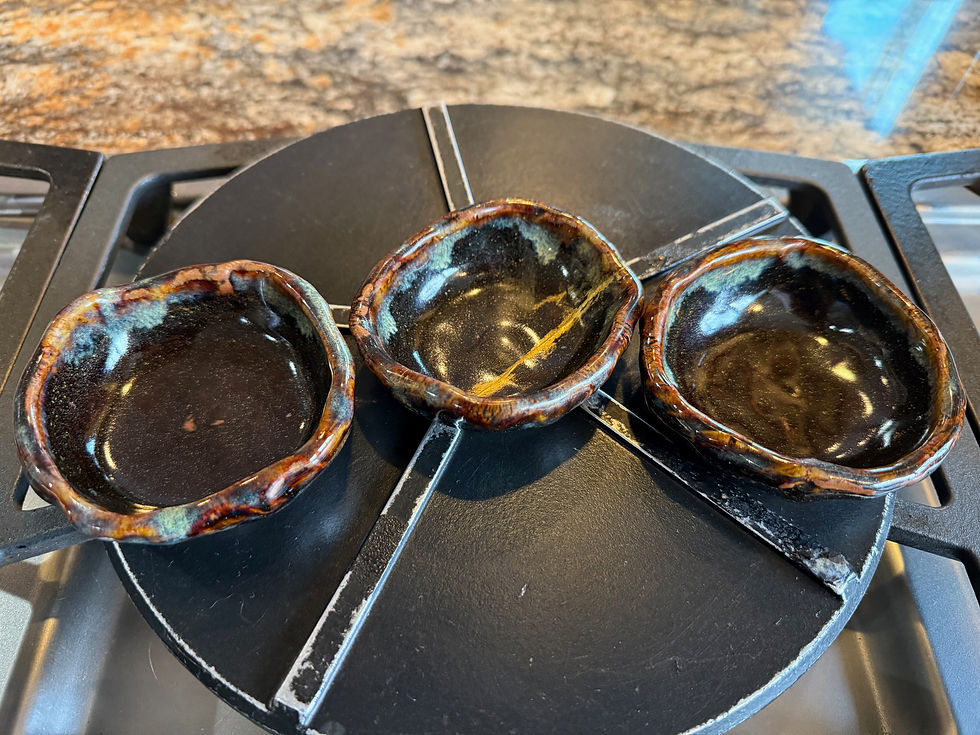
My parents' marriage is a kintsugi marriage. It cracked. It broke, almost, on the night my mom stood up and said I'm leaving. And then it was repaired — not invisibly, not without evidence of the damage, but with something that held. They have been married for 61 years. The gold seam is there if you know where to look.
My own marriage ended. My priest told me that when a marriage dies, you need to give it a funeral. That the Church, like the heart, needs a ritual to mark what has ended. I haven't done that yet. But I'm thinking about it differently now — not as an admission of failure, but as kintsugi in reverse: acknowledging the break as a way of honoring that something real, something golden, once existed.

What My Generation Learned (And Who Taught Us)

My mom's generation had Erma Bombeck.
Young women today may not know who she is, but they have her to thank in more ways than they realize. Erma Bombeck was a humorist who wrote about the chaotic, frustrating, often absurd reality of suburban family life in the 1970s — the expectation that women would keep the house, raise the children, and be happy about all of it. She didn't rage against it, exactly. She laughed at it. And in laughing at it, she named it. She fought for the Equal Rights Amendment. She said, in her particular witty way: We're not going to take this anymore.
The women of my mother's generation read Erma. They laughed at their own "oddities" — the impossible standards, the invisible labor, the careless words they may have absorbed from the men in their lives — because Erma laughed at hers first.
My generation inherited that laughter. We raised our sons to feel their feelings and do the dishes. We told our boys it was okay to babysit as a high school job. Some of us have sons who are considering being stay-at-home dads. My son Michael is one of them.
The crack in my mother's generation — the silence, the absorbed shame, the twenty years of words that should never have been said — didn't disappear. But it was repaired, slowly, generation by generation, with something that shines.
The Photograph

In 2016, my daughter was in high school taking AP Photography. Her final project involved asking people to write down an important message — something about themselves, something they wanted to say to the world — and then she photographed them holding it.
She asked me.
I wrote: Always be willing to listen to others, but listen most closely to your voice within. It will never let you down or lead you astray.
I have been thinking about that message this week — about my mom's inner voice, which finally spoke loudly enough that she stood up and said I'm leaving. About my own inner voice, which has led me through grief and divorce and reinvention and the slow, imperfect work of becoming more honest. About the voices we inherit from our parents — the eloquent ones and the cruel ones — and what we choose to carry forward.
My dad gave me language. My mom showed me what it means to stand in your own truth when everything is telling you to be quiet. My daughter photographed me holding the evidence of what I'd learned from both of them.
The crack runs through all of it. And where it runs, there is gold.

What This Has to Do With You
Here is the Investigative Parent question I'm sitting with this week, and I'm inviting you to sit with it too:
Where is the gold in your family's cracks?
Not to minimize the damage. Not to thank the people who hurt you for the lessons they inadvertently taught. Ann Patchett is clear on this — she does not thank her father for doubting her. She simply recognizes that once she stopped waiting for his approval, she was left with her own judgment. That is different from gratitude. It is something quieter and harder: the ability to continue without waiting for permission.
The kintsugi philosophy doesn't pretend the bowl was never broken. It doesn't erase the crack. It says: this happened, and it is part of you, and we will honor it rather than hide it.
Your family's cracks are part of your story. The repair is part of your story. The gold is part of your story.
You don't have to hide any of it.

About the Author
Cynthia Z. Stevens Copeland, MA, CCC-SLP is a speech-language pathologist with 30+ years of experience and the founder of Right Track Parenting. She created the Investigative Parenting methodology, teaching parents to "wonder before you worry, imagine before you interpret, create before you catastrophize." A certified parent coach and student of Dr. Martin Seligman's Foundations of Positive Psychology at the University of Pennsylvania, Cynthia writes from lived experience as a mother of five scattered across three continents, a widow, and a woman who has learned that the most honest stories are the ones we're most afraid to tell. She lives in Vienna, Virginia with her youngest son and two dogs who have never once waited for permission to love her. Like the kintsugi bowl in her kitchen, she is held together — beautifully, imperfectly — by everything she has survived.
© 2026 Cynthia Z. Stevens Copeland. All rights reserved.


Comments