
They're Raising You, Too
- righttrackparentin
- Apr 28
- 7 min read

There's a country song that accidentally gets it exactly right.
Easton Corbin wrote "Raising Humans" from the perspective of a rescue dog — a dog who arrives home in an old truck, spends hours on a couch with a heartbroken man, watches him heal, and finally drifts off at the vet thinking: he's going to be okay. The chorus goes: Raising humans ain't as easy as it looks / Raising humans don't come with instruction books / You just love 'em and you trust them / And sometimes let 'em think they know it all.
I've listened to that song more than once. And every time, I think: yes. Except the humans doing the raising aren't always the ones we expect.
Sometimes it's a dog.
And sometimes — more often than we ever admit — it's our children.
The Journal That Came From Paris
This past Christmas, my oldest daughter Calli — who has been living in Paris — gave me a gift I didn't expect: a blank journal from a small Parisian stationary shop that makes customizable journals by hand. Inside the front cover, she wrote: "Since you're always full of new ideas, I wanted to give you this to keep track of your projects, jot down new thoughts and manifest your deepest dreams."
She signed it: Calli — your first baby.
But she wasn't done. Before the blank pages began, she had assembled something extraordinary: notes from all five of my children, each paired with a photograph. She titled the page in large letters: NOTES FROM YOUR BIGGEST FANS.

I have five children. Calli is the oldest. Michael came second. Then Eva, who is now teaching English in Vietnam. Then Stella, finishing her freshman year at college. Then Sam, my youngest, who just got his driver's license and still writes in the earnest handwriting of a kid figuring out how to say what he means.
Each of them wrote to me. In their own words. With their own photos — pictures from across twenty-five-plus years of motherhood.
And here is what they said.
What They Taught Me Without Knowing It
Calli wrote that she loves France because of me. That she inherited my tenacity and desire for passion. That she can't wait for decades more.
Michael said I am strong and full of joy — and thanked me for instilling those traits in him.
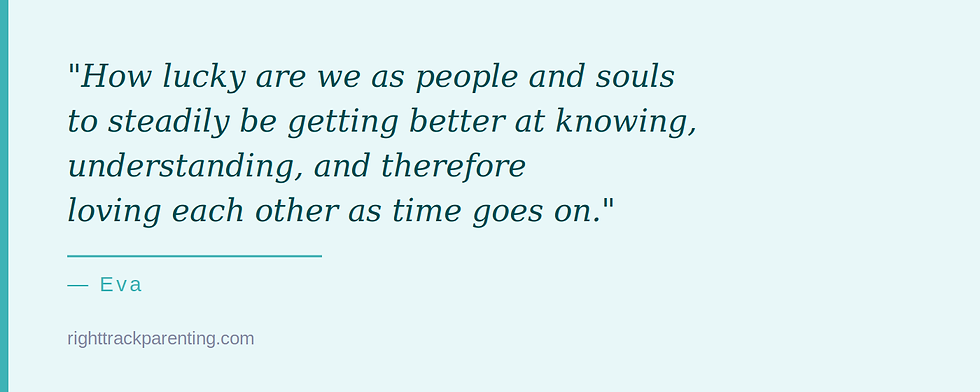
Eva — my third baby, who I am holding as a tiny infant in her photo — asked, Where does a girl even begin when it comes to writing about her beloved mother? And then she wrote something that stopped me cold:
Stella, my fourth, away at college for the first time, wrote: I love sitting with you even in silence.
And Sam — my fifth baby, my youngest — said: I love you so much. Thank you for everything you do for me, especially taking me where I need to go even when you're busy.

I have read developmental research for thirty years. I have studied attachment theory, positive psychology, family systems. I have sat with hundreds of families in some of the most tender and uncertain moments of their lives.
And I want to tell you: nothing I have ever read prepared me for the experience of having my own children turn around and reflect me back to myself. Not as I feared I was. As I actually am.
Eva is the one who said it most clearly — steadily getting better at knowing, understanding, and therefore loving each other as time goes on. That is not a daughter describing her mother. That is a daughter describing a relationship that moves in both directions — two people, growing together, across time.
She learned that somewhere. I'd like to think I had something to do with it.
But I know she also taught it to me.

The Parent You Were, and the One They Made You
Here is something I believe with my whole clinical and personal self: the parent you were for your first child is not the parent you were for your second, your third, your fourth, or your fifth.
It isn't just experience. It isn't just getting better at the logistics of keeping humans alive and reasonably regulated. It's that each child calls something forward in you that didn't exist before them. A particular patience. A particular willingness to be wrong. A particular capacity to love someone who is absolutely, unmistakably not you — who will grow up and move to Paris, or teach English in Vietnam, or sit beside you in comfortable silence, or text you from the car he just learned to drive.
I think of my five in terms of ordinal numbers — not as a ranking, but as the order in which they arrived to me. My first baby. My second baby. My third, fourth, fifth. Each one changed me. Each one made me a different version of myself. And as the numbers got higher, so did the evidence of their influence.
Calli didn't just grow up in my house. She grew up in my presence — and I grew in hers. She is the one who has known me the longest. And she is the one who looked at the woman I am today and thought: she needs a journal. She needs space to keep track of her ideas and manifest her dreams. She saw what I needed before I did.
That is not a child being raised. That is a child doing the raising.

On Experts, and Who Actually Knows Your Child
I want to say something directly, because I am building toward making it a cornerstone of my work:
We have a problem with expert culture in parenting.
I have enormous respect for researchers and clinicians who have dedicated their lives to understanding child development. The science matters. The frameworks matter. I have spent thirty years contributing to that work, and I will spend the rest of my career doing the same.
But the way "expert culture" lands on parents — as if there is one correct method, one certified approach, one system your family should be running through — does something corrosive. It tells parents that the knowledge lives out there, with someone credentialed and distant, rather than in here, with the person who knows this child.
Let me be clear: no expert has ever sat in your kitchen at 7am with your particular human, navigating your particular morning. That knowledge belongs to you.
What parents need is not more expertise. They need a co-pilot. Someone to sit beside them while they read the map they're already holding. That is what I have tried to be in my years of early intervention practice. And it is exactly what I am building with LUMA, the AI parenting companion at the heart of RaisingHumans.ai — not an authority, but a presence. Not answers, but questions asked with genuine curiosity.
The parent in the room is always the world's foremost expert on their own child. My job — every time — is to help them trust that.
The Homework My Daughter Assigned Me
Calli included something else in the journal before the blank pages began: a list of exercises for introspection. Write a letter to your inner child. Write from yourself in fifty years. Write a day in your present life as you want it to be three to five years from now. Make a gratitude list. Make a vision board.
I did some of them.
I wrote a letter to myself at five years old — standing at the edge of kindergarten, the future wide open, about to encounter for the first time all the adults in the world who are not my mom and dad. I told her: some of them will appreciate your energy, your personality, your way of being. Some will not. Be polite to those who don't. Forge deep bonds with those who do. And learn from all of them.
I signed it: Cindi at 59.

Then, five days ago — April 22nd — I opened the journal during what I wrote at the top of the page as a downturn in attitude. I listed my fears raw, without editing them: What if I fail? What if no one wants LUMA? What if she scares people or makes them doubt their own strengths to solve their own problems?
I drew a line across the page.
And then I answered myself, the way I would answer any parent sitting across from me.


A woman with an advanced degree and thirty years of clinical experience, working through the journal prompts her daughter brought from Paris.
That is not weakness. That is exactly what growth looks like from the inside.
The Instruction Book That Doesn't Exist
My children watched me. And somewhere along the way — through the moves and the losses and the new beginnings, through the five different versions of myself I became as each of them arrived — they learned something worth reflecting back.
They learned that you keep going. That you stay curious. That you write your fears down and then draw a line and answer yourself. That you are never too old or too credentialed or too experienced to do the homework.
Easton Corbin's dog knew: Raising humans don't come with instruction books.
Neither does being raised by them.
But if you pay attention — if you practice wondering before you worry, staying curious before you conclude — you'll notice it happening. Your child, in a note tucked into a Paris journal, telling you who you are. Your daughter, from Vietnam, reminding you that steadily getting better at knowing each other is the whole point. Your youngest, in earnest handwriting, thanking you for showing up even when you're busy.
That is not the end of your parenting. It is the evidence of it. And it is, if you let it be, an invitation to keep growing — right alongside the humans you're raising.

About the Author
Cindi Z. Stevens Copeland, MA, CCC-SLP, is a speech-language pathologist with more than 30 years of experience working with children and families. She is the founder of Right Track Parenting and the creator of the Investigative Parenting methodology — a research-backed framework that guides parents to wonder before they worry, imagine before they interpret, and create before they catastrophize. Cindi holds a Certificate in the Foundations of Positive Psychology from the University of Pennsylvania and is a certified Parent Coach through the Parent Coaching Institute. She runs a direct-pay private practice in Northern Virginia and is the creator of LUMA, an AI-powered parenting assistant available at RaisingHumans.ai (coming soon!). Learn more about Cindi and Right Track Parenting at righttrackparenting.com.
© 2026 Right Track Parenting. All rights reserved. No part of this blog may be reproduced or distributed without written permission.


Comments