
Planting for a Century
- righttrackparentin
- Mar 17
- 7 min read

Every Thursday morning, I walk into a preschool classroom and a little girl looks up from whatever she's doing and says the same thing:
"Wait! I have something for you."
Then she goes to her cubby.
This particular Thursday, she came back with a worksheet. At the top, in cheerful block letters: When I Am 100 Years Old...
She had filled in the self-portrait box with stickers. A bunny that said "keep it up." A dreaming cat. A sparkly heart. She had scribbled blue crayon across the "I will wish for 100" box with the concentrated ferocity only a four-year-old can muster. And in the "I will be..." box, she had placed a sticker — decorating the page the way she decorates everything, with complete and guileless joy.
She made it for me. That's all she was thinking.
I held that paper for a long moment, thinking something she wasn't thinking at all.
We were heading to the school library, where we'd spend the next thirty minutes working on her sh sound — shoe, wishing, dash — the kind of quiet, repetitive, patient work that looks like very little from the outside and adds up to everything over time. But I kept coming back to the worksheet.
She's probably going to see 100.
The science is on her side. Life expectancy trajectories, medical advances, AI-driven diagnostics — this child, who is not yet five years old and still mastering sounds that most of us take for granted, is very likely to live a century. She is going to witness technological and medical changes that none of us can fully imagine. She is going to navigate a world that is being built right now, faster than any of us can track.
And right now, in a school library on a Thursday morning, we are building her.
That's the long game. And it starts with small tries.
I Was Not an Easy Child to Plant
I need to tell you something about myself before we go any further.
I am a Fire Horse.
In Chinese astrology, the Fire Horse — a combination that only occurs every 60 years — is known for intense energy, fierce independence, and a temperament that adults have historically described as "uncontrollable." I was born in December of 1966, and my mother will be the first to tell you that the description fits. As it happens, the Year of the Fire Horse began again on February 17, 2026 — which means this particular blog is landing in a Fire Horse year. Make of that what you will.
I gave up my nap before age two. I burned energy from dawn to dark. I was, by most accounts, a handful.
And then I became a teenager.
My parents, God love them, did what most parents do when faced with a strong-willed child careening toward independence: they pulled the reins. Hard. And the harder they pulled, the harder I pulled back. My therapist in high school put it this way when she talked to my mother: parenting a teenager is like Chinese handcuffs. The harder you pull, the tighter it gets. The moment you ease up — the moment you release a little — there's suddenly less resistance. Things breathe again.

I've thought about my parents a lot since I read about Warren Buffett's approach to raising his own strong-willed kids. I think they would have done better with me — and I might have given them a little less gray hair — if they'd known what Buffett's father seemed to understand instinctively.
"I Know You Can Do Better"
Warren Buffett was not always the composed, folksy grandfather of American investing. By his own admission, he was something of a jerk as a teenager — a kid who misbehaved and pushed limits. But his father, a stockbroker and congressman, wasn't too bothered. Instead of lectures, instead of punishment spirals, instead of tightening the handcuffs, he had a different response.
"I know you can do better."
That was it. Quiet. No drama. Just a steady, confident belief that his son had both the shortcomings his father could see clearly — and the potential to rise above them. Buffett later called it "very powerful stuff," because he knew his father was right on both counts.
It worked. Warren Buffett went on to boil his own parenting philosophy down to one sentence: "If you want to have good children, be a good parent." His three children grew up expecting nothing, became philanthropists, and describe their childhood as remarkably undramatic. No lectures. No yelling. Just a parent quietly living his values in front of them, over a very long time.
I started using "I know you can do better" with my son Sam almost immediately after reading this. The first time was when he was speaking to me in a way that wasn't his best self. The second time was when he was tormenting our dog Ivy — running up to her and shouting in her face, the way teenage boys sometimes do when they're bored and think it's funny.
"I know you can do better than that."
He stopped. There was a beat — that split second where you can almost see the recalibration happening — and then he backed off. He knew I was right. About the shortcoming and the potential. He asked me later why I kept saying that. I told him: because I know it's true.

I'll be saying it alongside my other staple: Make good choices. That one I've said to every one of my children every time they walked out the door for a night out, a school trip, a spring break. At airport drop-offs. At the door. So many times that I suspect they can hear it in their sleep.
These are small tries. The game is very long.
The Teenager Who Doesn't Want to Listen (And Why That's Actually Neurological)
Here's the thing that makes all of this both harder and, somehow, more hopeful: the fact that your teenager isn't listening to you is not a personal failing. It's a biological event.
Around early adolescence, something remarkable happens inside the developing brain. The mother's voice — once the strongest and most comforting sound in a child's world — begins to lose its automatic priority. This isn't rejection. It's neurological growth. The brain is preparing for independence. By thirteen, children start tuning into a wider social environment — peers, new mentors, the outside world. Their emotional and cognitive systems are restructuring, building the identity and confidence they'll need to navigate life beyond your roof.
Parents often misinterpret this shift as attitude or distance. But teens still hear you. Their attention just doesn't snap to your voice the way it once did. And research consistently shows that teens don't respond well to being told by adults what to think or do, even when it could genuinely help them. One Australian study found that teens who received a more intensive therapeutic intervention actually reported worse mental health outcomes and worse relationships with their parents than those who received a basic health class. Heavy-handed intervention often backfires.
What works, it turns out, is something much quieter. Something that looks, from the outside, like almost nothing.
The Science of Showing Up
The Dunedin Study in New Zealand tracked 1,000 people for more than 40 years. What they found should stop every parent in their tracks: the strongest predictor of financial success by the time subjects reached their 30s wasn't IQ. It wasn't the wealth of the family they grew up in. It was cognitive control — the ability to understand their emotions and choose wisely how to respond to them.
Psychologist Daniel Goleman summarized it plainly: how well you do in your life depends on your levels of cognitive control. And those skills? Kids learn them best by watching their parents model them. Not through programs. Not through lectures. Through daily, unglamorous, repeated demonstration.

You cannot be at every stop sign. You cannot be in every dorm room. Once children reach a certain level of independence — and they will, they're supposed to — the direct levers of control are largely gone. What remains is what was built during formation: the values, the habits of mind, the internalized voice that says I know you can do better.
This past weekend, Sam filled me in on some of what's going on in his friend group. Stella came home for spring break with stories of eighteen and nineteen-year-olds doing what eighteen and nineteen-year-olds have always done. And I sat with all of it the way I've learned to sit with all of it.
I did all I did. I hope I raised them right.
That's not resignation. That's the long game.
Planting for a Century
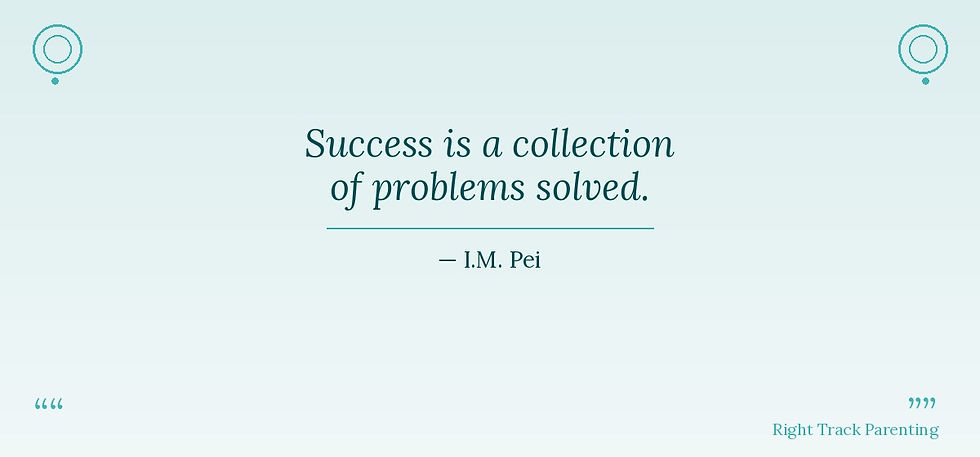
Not one grand design. A collection. Problem by problem. Session by session. Thursday by Thursday.
Brooklyn is going to live to see things none of us can imagine. She is going to need cognitive control, and empathy, and values, and the ability to make good choices in a world full of options that don't yet exist. The people building her right now — her family, her teachers, her SLP — won't be there for most of it. We are planting for a century we won't see.
The business world has started to understand something similar about this particular moment in history. As AI reshapes every industry, the clearest-eyed leaders are saying that this era will not be defined by technology alone — but by how we choose to cultivate, value, and safeguard the power of the human mind. The ability to reason critically, imagine boldly, and navigate complex and abstract ideas is becoming the most essential human skill of the future.
We build that in children. Not in a program. Not in a single defining moment. In Thursday mornings. In "make good choices." In "I know you can do better." In being the parent who quietly lives the values they want to see, day after day, for years and years and years.
Andy Murphy writes about what he calls the 54% Rule: in any long game, not everything works. Seedlings don't all make it. Some investments go to zero. Some workouts feel like a complete waste. But plant enough seeds, stay consistent long enough, and the compounding begins. Over time, confidence grows and commitment deepens. That, he writes, turns out to be a recipe for a lot of small wins in life.
Parenting is the original long game.
Brooklyn handed me a piece of paper. She was just making me something pretty.
I'm keeping it forever.
Keep planting. 🌱

About the Author
Cindi Z. Stevens Copeland, MA, CCC-SLP, is a speech-language pathologist with more than 30 years of experience in early intervention and child development. She is the founder of Right Track Parenting and the creator of the Investigative Parenting methodology — wonder before you worry, imagine before you interpret, create before you catastrophize. She writes weekly about the intersection of research, storytelling, and the beautifully messy work of raising humans.
She thinks about the children she works with the way a gardener thinks about trees — tending carefully to something she will not live long enough to fully see.
© 2026 Cynthia Z. Stevens Copeland. All rights reserved.
Sources available upon request


Comments