
The Smartest Thing You Can Do For Your Child Has Nothing To Do With "Smart"
- righttrackparentin
- Mar 10
- 14 min read
Updated: Mar 11

Last week, as I was clearing out the Old Gray Mare before she got towed, I took the bumper magnets off my car. VT. VCU. JMU. The Mill. GCM. Each one cut to the shape of its own letters — no uniform ovals, just the distinct outlines of my people and the places that shaped them. Stella is still being shaped by JMU — she's only a freshman. And Sam is still being shaped by Marshall High School (GCM) — he's only a sophomore. And honestly? I'm still being shaped too, by The Mill, my CrossFit gym, where I keep showing up and surprising myself. I held them all in my hand for a minute before putting them away. And then I thought: what would I put there instead, if the world finally started measuring what actually matters?
This morning I knocked on the door of a family I work with. When the door opened, I got my answer. Hazel's mom was standing there smiling — and across her sweatshirt, in big, bold, colorful letters, was one word: EMPATHY.
The Universe, it seems, is not being subtle this week.
The Old Formula Is Breaking Down
Jensen Huang, the CEO of Nvidia — the company that builds the chips powering the artificial intelligence revolution — stood before students at Cambridge University not long ago and said something that rattled a lot of people.
He told them that the era of raw intelligence as a competitive advantage is ending. That AI doesn't just compete with human intelligence — it laps it. It can score 100% on a test before you pick up your pencil. It can summarize a legal brief, write cleaner code, and diagnose disease patterns in seconds. Raw intelligence, he argued, is becoming like tap water: vital, yes, but cheap, abundant, and available to anyone with a Wi-Fi connection.

And it's not just Nvidia saying so. LinkedIn CEO Ryan Roslansky recently declared that "the future of work belongs not anymore to the people that have the fanciest degrees or went to the best colleges." His own platform's data confirms it: as AI literacy becomes a baseline expectation, what employers are hungry for now is empathy. Human connection. The ability to read a room, inspire trust, and navigate relationships — the skills that can't be automated.
One CEO put it even more bluntly: the "commoditization of intelligence" means hiring the smartest people is less important than developing staff who have management skills. The smartest person in the room is no longer the most valuable person in the room.
If you're a parent who has spent years pushing your child toward academic excellence — all A's, the right college, the tutoring center on Saturday mornings — this might feel threatening. I understand that. But I want to offer you a reframe, because I think this moment, as unsettling as it is, contains one of the most hopeful shifts in parenting I've seen in my thirty-plus years of working with children and families.

The IQ Arms Race: A Brief, Honest History
For decades — really since the post-World War II economic boom redefined the American Dream — we organized our parenting around a single premise: intellectual achievement is the key to a secure future.
And so an industry was born.
Private tutoring centers in the United States more than tripled between 1997 and 2022 — from roughly 3,000 to over 10,000 locations — concentrated almost entirely in high-income areas where parents had both the financial resources and the anxiety to invest. The global private tutoring market was worth nearly $100 billion in 2023. In the United States alone, it's a multi-billion dollar industry growing year over year.
Parents hired SAT tutors. They paid college admissions consultants. They enrolled their kids in enrichment programs, STEM camps, and coding classes. Some families arranged service trips abroad — not because their child was passionate about international development, but because it would look good on a college essay.
I am not judging those parents. I have been one of those parents, doing the best I could with what I understood to be true about how to help my children succeed in life. And the truth is, most of us were working from the same inherited belief: that academic smarts were the ticket.
But here's what the Bell Curve never told us: intelligence, as we've measured it, has always been an unequalizer. It was distributed unequally at birth, rewarded unequally in school, and leveraged unequally in the workplace. A whole lot of beautiful, capable, worthy human beings were told — explicitly or implicitly — that they weren't quite smart enough. And they believed it.
I've been thinking about a tutoring center near my house. I used to drive past it with my son Sam and feel a pang — not of superiority, but of something more complicated. Grief, maybe. For the children inside spending their Saturday afternoon doing math drills. For all the kids whose worth was being calculated in percentile points rather than curiosity, kindness, or creativity. And if I'm honest: some guilt about the years I couldn't afford to give my own children those kinds of advantages, while other parents could.
That's the messy, human truth underneath the grief and the guilt — feelings I didn't even know were there until I sat with them long enough to look. And that's exactly the kind of emotional excavation that AI will never be able to do for us.
I see a version of this same tension in my early intervention work every week. Parents beam with pride when their two-year-old can identify colors, recite numbers, or recognize letters of the alphabet well enough to place them in a puzzle. And I smile with them — genuinely. But inside I'm gently asking: what can your child do with that? Can they make a request to get what they want or need? Can they respond to a question during play? Can they manage a big feeling when they can't have what they want? Those are the skills that will carry them — not just into kindergarten, but into a lifetime of human connection.
What AI Cannot Do
Here is where I want to slow down, because I think this is the heart of everything.
AI is extraordinary at tasks that involve pattern recognition, information retrieval, summarization, and performance. It can take notes. It can write essays. It can pass tests. It can produce a competent — even impressive — output on almost any academic task you hand it.
What it cannot do is understand.
Not really. Not in the way a human being understands — through lived experience, emotional resonance, relationship, and the hard work of making meaning.
I see this every week in my work as a speech-language pathologist. I have a private client named Graeme — a 19-year-old young man with autism whom I've been working with since he was six years old. I have watched him grow from a disorganized, verbally limited little boy into a thoughtful, articulate young man who is now taking college courses in comparative politics and globalization.
And here is the tension I navigate with him every single week.
His devoted caregiver, who loves him deeply, encourages Graeme to take notes on his readings and videos. She wants him to succeed, and notes feel like success — tangible, visible, productive. When she sets up our sessions, the request is often: "Please do the reading with Graeme and help him take notes."
But I keep gently redirecting us. Because Graeme doesn't need to copy information down. He needs to understand it. He needs to be able to explain it in his own words. To debate it. To connect it to something he already knows. To teach it back to me.
That's the difference between a student and a learner. And in an AI world, only learners are irreplaceable.

A Mexican high school teacher named Gaby Rogut wrote recently that students have been trained to treat grades like a salary — the reward for doing the job of school. Learning, she observed, becomes secondary. Something you pursue only if there's time and energy left over.
Graeme is not the problem. The system that taught us to prioritize notes over understanding, performance over comprehension, output over insight — that's the problem. And it's a problem AI is about to expose, loudly, for every family that has been playing the academic achievement game.

The Great Equalizer
So here is the hopeful part. The part that made me want to write this week.
If IQ has been the great unequalizer — distributed unevenly, rewarded unevenly, used to sort and rank human beings in ways that left too many people feeling lesser — then EQ, emotional intelligence, is the great equalizer.
Because every human being — regardless of where they fall on any Bell Curve — has the capacity to feel. To connect. To understand another person's experience. To name what's happening inside themselves. To regulate, to empathize, to repair a rupture in a relationship, to sit with uncertainty without collapsing.
These are not gifts reserved for the intellectually gifted. They are not correlated with SAT scores or GPA. They are developed — through modeling, through practice, through safe relationships in which children learn that their inner world matters.
And they are exactly what an AI-driven world will need most.
Think about it: what will distinguish a human professional from an AI tool in ten years? Not the ability to retrieve information — AI will always win that race. Not the ability to produce competent written output — same. What will matter is the ability to read a room. To navigate conflict. To inspire trust. To notice what isn't being said. To lead with empathy. To make meaning from suffering.
These are EQ skills. And parents develop them — or fail to develop them — in their children every single day, not through tutoring programs, but through presence, attunement, honest conversation, and the courage to feel things out loud.
A note worth adding here: a psychologist named Julian Frazier recently wrote that he's stepping away from the term "emotional intelligence" — arguing that EQ can't be quantified the way IQ can, and that different emotions require entirely different skill sets to navigate. He's onto something important. Empathy and anxiety and awe and grief are not all handled by the same muscle. UC Berkeley researchers have identified 27 distinct categories of human emotion — not six, not the emoji wheel — 27 nuanced, interconnected, fuzzy-edged experiences that make up our inner lives. Getting good at all of them takes a lifetime of practice.
But here's where I gently push back on Frazier: the fact that emotional capacity can't be reduced to a score doesn't mean it isn't real, developable, and desperately needed. It means we need to take it more seriously, not less — with more specificity, more intention, and more of exactly the kind of work parents do every day when they sit with their children in the hard feelings instead of rushing past them.
My Daughter Eva

I want to tell you about my daughter Eva.
Eva is a poet and a painter. She is one of the most empathic people I know — someone who feels the highest of the highs and the lowest of the lows with her whole body. She is, as I sometimes think of her, my heart walking around outside my chest. I recognize myself in her completely.
Eva is also deeply suspicious of artificial intelligence. She finds it offensive, honestly — an affront to the artist's sensibility, to the irreducible humanness of creative work. When I mention that I use AI to help me organize my thoughts for this blog, I can feel her bristle a little. She would never.
And here's what I've been sitting with this week: Eva is exactly what an AI-driven world needs.
She feels everything. She notices everything. She connects across difference with an openness that most people spend decades trying to cultivate. She creates meaning out of experience in ways no algorithm can replicate. Her suspicion of AI isn't a failure of adaptability — it's evidence of the very thing that will make her irreplaceable.
The big feelers — the artists, the empaths, the people who are so tuned in to human experience that a machine's approximation of it feels hollow and wrong — these people have always been undervalued in the IQ economy. The AI economy is going to need them desperately.
I also think of my mother, who, whenever I describe how well my AI assistant understands my voice and my goals, responds with a quiet: "That's scary." And my therapist Shelly, who gets a little uncomfortable when I say "Claude said..." I find this so interesting. The people most attuned to authentic human connection are the ones most wary of its simulation. That instinct is not irrational. It's wisdom. It's discernment. It's the EQ alarm system working exactly as it should.

I Saw This Coming
Here is something I haven't shared publicly before.
Back in 2012 — when Google was becoming the answer to every question and Siri was just learning to talk — I sat down and wrote a list of skills I believed every child would need to thrive in the 21st century. Not for a blog. Not for a conference. For a curriculum I was developing called the Operation Ready By 3 Infant-Toddler Curriculum, built from years of sitting on the floors of living rooms and therapy rooms with children and their families as well as with my own children.
I knew then that the internet had changed everything. If information was free and instant, memorizing it wasn't the point anymore. What would matter — what would always matter — was what children could do with what they knew. How they could communicate it, debate it, connect it to someone else's experience, and use it to build something together.
Good grades was not on the list. Neither was GPA, test scores, or the ability to take notes efficiently.
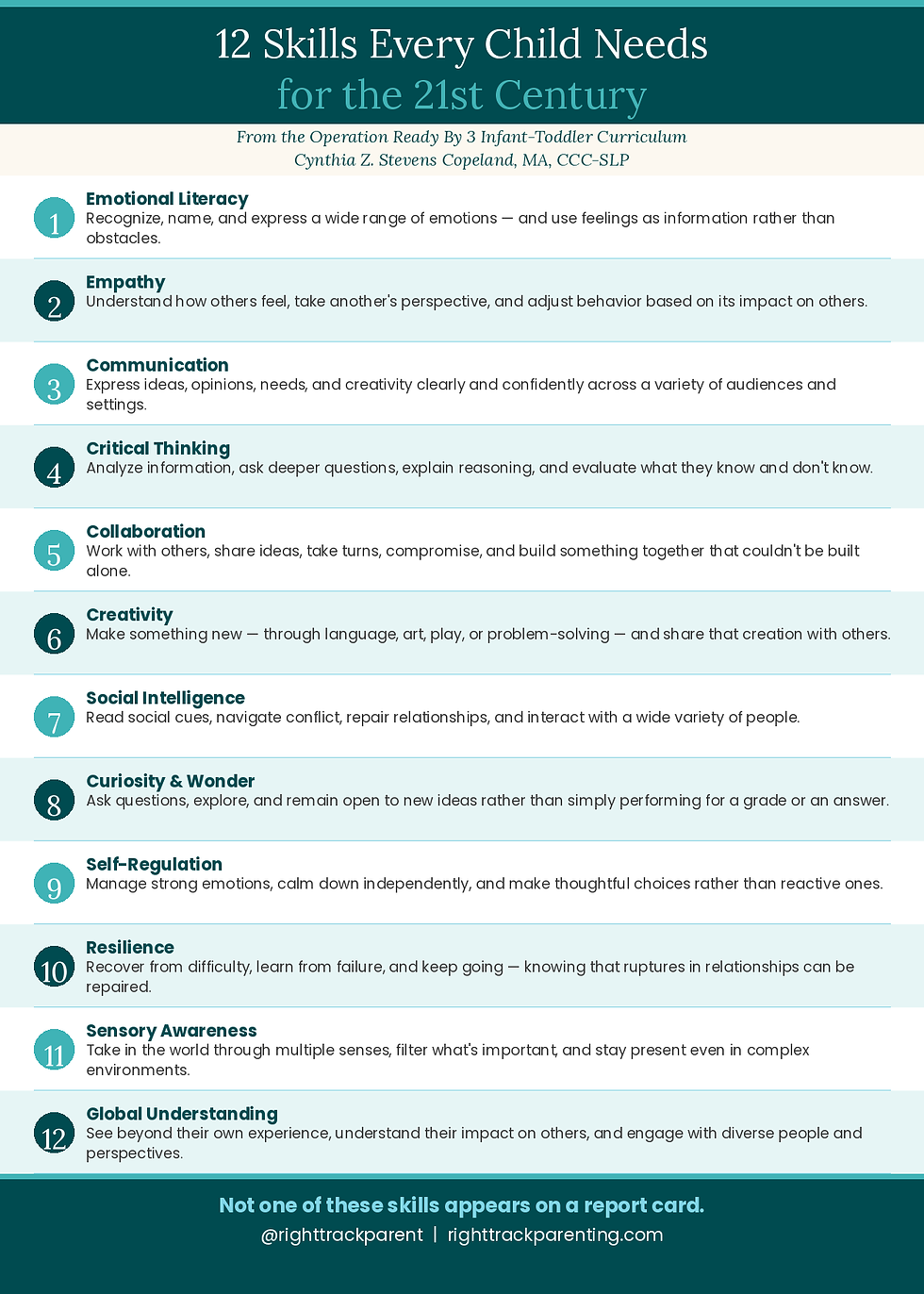
Here is what was on the list — twelve skills that I believe, more today than I did then, are the true measures of a child ready for school, for work, and for life:
The 12 Skills Every Child Needs for the 21st Century (From the Operation Ready By 3 Infant-Toddler Curriculum — Cynthia Z. Stevens Copeland, MA, CCC-SLP)
1. Emotional Literacy — the ability to recognize, name, and express a wide range of emotions in themselves and others, and to use feelings as information rather than obstacles.
2. Empathy — the ability to understand how others feel, take another's perspective, and adjust behavior based on how it affects the people around them.
3. Communication — the ability to express ideas, opinions, needs, and creativity clearly and confidently across a variety of audiences and settings.
4. Critical Thinking — the ability to analyze information, ask deeper questions, explain their reasoning, and evaluate what they know and don't know.
5. Collaboration — the ability to work with others, share ideas, take turns, compromise, and build something together that couldn't be built alone.
6. Creativity — the ability to make something new — through language, art, play, or problem-solving — and to share that creation with others.
7. Social Intelligence — the ability to read social cues, navigate conflict, repair relationships, and interact effectively with a wide variety of people.
8. Curiosity and Wonder — the disposition to ask questions, explore, and remain open to new ideas rather than simply performing for a grade or an answer.
9. Self-Regulation — the ability to manage strong emotions, calm down independently, and make thoughtful choices rather than reactive ones.
10. Resilience — the ability to recover from difficulty, learn from failure, and keep going — including the understanding that ruptures in relationships can be repaired.
11. Sensory and Environmental Awareness — the ability to take in the world through multiple senses, filter what's important, and stay present and engaged even in complex or distracting environments.
12. Global and Cultural Understanding — the ability to see beyond their own experience, understand that their actions affect others, and engage with diverse people, ideas, and perspectives.
Jensen Huang stood up at Cambridge and said smart is becoming a commodity. LinkedIn's CEO said degrees are no longer the measure of a future employee. I wrote this list in 2012. I didn't have their platforms or their audiences. But I had twenty years of children at the time, and I knew.

What Parents Can Do — Starting Now
C.S. Lewis wrote: "You can't go back and change the beginning, but you can start where you are and change the ending."
If you've been parenting in the IQ economy — prioritizing grades, test scores, the right extracurriculars — I am not asking you to feel guilty. You were working from the best map available. We all were.
But the map is changing. And the beautiful thing is, the new map asks something of you that doesn't require money, connections, or the right zip code. It asks you to be emotionally present. To model vulnerability. To help your child develop a relationship with their own inner world — all 27 emotions of it.
Here is what that looks like in practice:
Ask questions that require understanding, not just recall. Instead of "How did you do on the test?" try "What did you learn this week that surprised you?" or "Can you explain that concept to me like I know nothing about it?" When children can teach, they understand. When they can only recite, they've performed.
Name feelings in your home — yours and theirs. EQ begins with emotional vocabulary. Children who grow up in homes where feelings are named, discussed, and treated as information — rather than problems to be managed — develop the internal architecture for emotional intelligence. You don't need a curriculum. You need to say "I'm frustrated right now" and "I notice you seem sad — do you want to talk about it?"
Let your child see you fail and recover. One of the most powerful EQ lessons a parent can offer is the repair — the moment after you've lost your temper or made a mistake where you come back, acknowledge it, and reconnect. This teaches children that rupture is not the end of relationship. That is emotional resilience. AI cannot model it. Only you can.
Resist the urge to do it for them. Whether it's homework, a difficult friendship, or a hard conversation — the struggle is where the learning lives. An AI can write the essay. It cannot teach your child how to sit with the discomfort of not knowing and find their way through.
Value curiosity over performance. The child who asks "but why does it work that way?" is developing something more durable than the child who memorizes the answer. Wonder is a habit. Nurture it.
Get curious about the full range of human emotion — yours and your child's. Research now identifies 27 distinct categories of human emotion. Not just happy and sad. Nostalgia. Awe. Aesthetic appreciation. Adoration. Entrancement. The more words your child has for what they feel, the more power they have over it — and the more deeply they will be able to connect with another human being across a lifetime.
The Ending We Get to Write
Here is what I believe, as both a clinician and as a mother of five who has made every mistake in this book and learned most of what I know from the fallout:
Every human being — every one — has the capacity for emotional intelligence. It is not fixed. It is not inherited. It is grown, slowly, in the soil of safe relationships and honest reflection.
I did not learn EQ in school. I learned it in therapy. In friendship. In love. In loss. In sitting with my own discomfort long enough to understand where it came from. In taking a positive psychology course at Penn that gave me language for what I had always intuitively known.
If you're reading this and thinking: but I didn't get that modeling either — I know. Neither did I, not fully. My own emotional education was patchy and late and sometimes painful. But here we are, starting where we are, changing the ending.
That is what parents do. That is what humans do. That is the one thing no AI will ever be able to do for us.

The world is not asking your child to be smarter. It is asking your child to be more human. And that, it turns out, is something you are perfectly positioned to teach.
Maybe one day soon, instead of VT and JMU and honor roll bumper stickers, we'll start seeing something different on the backs of cars. Something like: Creative. Collaborator. Resilient. Great Listener. People Person.
Those are the magnets I've always wanted for my children. The world is just now catching up.
About the Author
Cynthia Z. Stevens Copeland, MA, CCC-SLP, is a speech-language pathologist with more than thirty years of experience, specializing in early intervention. She is the founder of Right Track Parenting and the creator of the Investigative Parenting methodology — Wonder Before You Worry, Imagine Before You Interpret, Create Before You Catastrophize. She is also a certified parent coach and a mother of five. If her car bumper told the real story, it would say: Empathetic visionary. Curious. Storyteller. Still learning.
© 2026 Right Track Parenting. All rights reserved.


Comments