
You Don't Have to Pass It On
- righttrackparentin
- May 26
- 7 min read
On daughters, inherited weight, and the moment someone decides the boulder stops here

Last week I wrote about carrying. This week I need to talk about putting something down.
The Silence of It
It starts with a reel on Instagram.
Four women — great-grandmother, grandmother, mother, young daughter — standing together against a warm ochre background. The great-grandmother holds a boulder. Not a small rock. A boulder. She passes it to the grandmother without a word, without ceremony, the way you'd hand someone a casserole dish or a set of keys. Here. This is yours now. The grandmother passes it the same way to her daughter. No expression. Businesslike. As if it were simply the order of things.
And then the blond woman — the youngest mother in the chain — takes the boulder, holds it for a moment, and does something no one in the video has done before.
She exhales. Deep and long.
And then she puts it down.
A wreath of flowers appears in her hands instead. She places it gently on her daughter's head, and the little girl smiles, and the mother smiles back — not with relief exactly, but with the quiet confidence of someone who has just made a decision she knows is right.
The Spanish caption reads: Hay cargas que viajan silenciosamente de generación en generación — there are burdens that travel silently from generation to generation.
I watched the reel three times. Then I sent it to my daughters.

Boulders Wrapped in Virtues
Here is what makes a boulder so hard to put down: it doesn't look like a boulder. It looks like the best version of you.
My great-grandmother stayed in her marriage through decades of difficulty — and she called it duty. My grandmother stayed too, and she called it endurance. My mother handed me bootstraps and told me to pull, told me to act like I had "more German in me" (she is 100% German and quite businesslike), and she called it resilience. Every boulder in my family line came wrapped in a virtue so that when it was handed to me, I didn't feel its weight so much as its honor. This is who we are. This is what we do.
I didn't like to sew or knit. I was a tomboy who climbed trees when I was supposed to be learning to be soft. My mother had thoughts about that — she voiced them, over time — and what I heard underneath wasn't criticism so much as confusion. If you are different from me, what does that say about me?
That is the question at the heart of every mother-daughter boulder exchange. We don't ask it out loud. But it is always there.
With sons, we expect difference. We build it into the story from the beginning — he's a boy, he'll make his own way, that's how it's supposed to work. The individuation of a son is legible. It has a name and a cultural script.
With daughters, we expect a mirror. And when the mirror shows something other than our own reflection — a woman who won't hold what we held, who exhales where we endured — it can feel like a verdict. If she won't carry what I carried, does that mean I was wrong to carry it?
The answer, it turns out, is sometimes yes.

What It Took
I didn't put my boulders down all at once. I tried for years — in a marriage that wasn't right for me, carrying the weight of you took a vow before God and your loved ones and now you have to remain no matter what long past the point when remaining made sense for anyone, including my children. The boulder of commitment, dressed up as honor. The boulder of endurance, dressed up as strength.
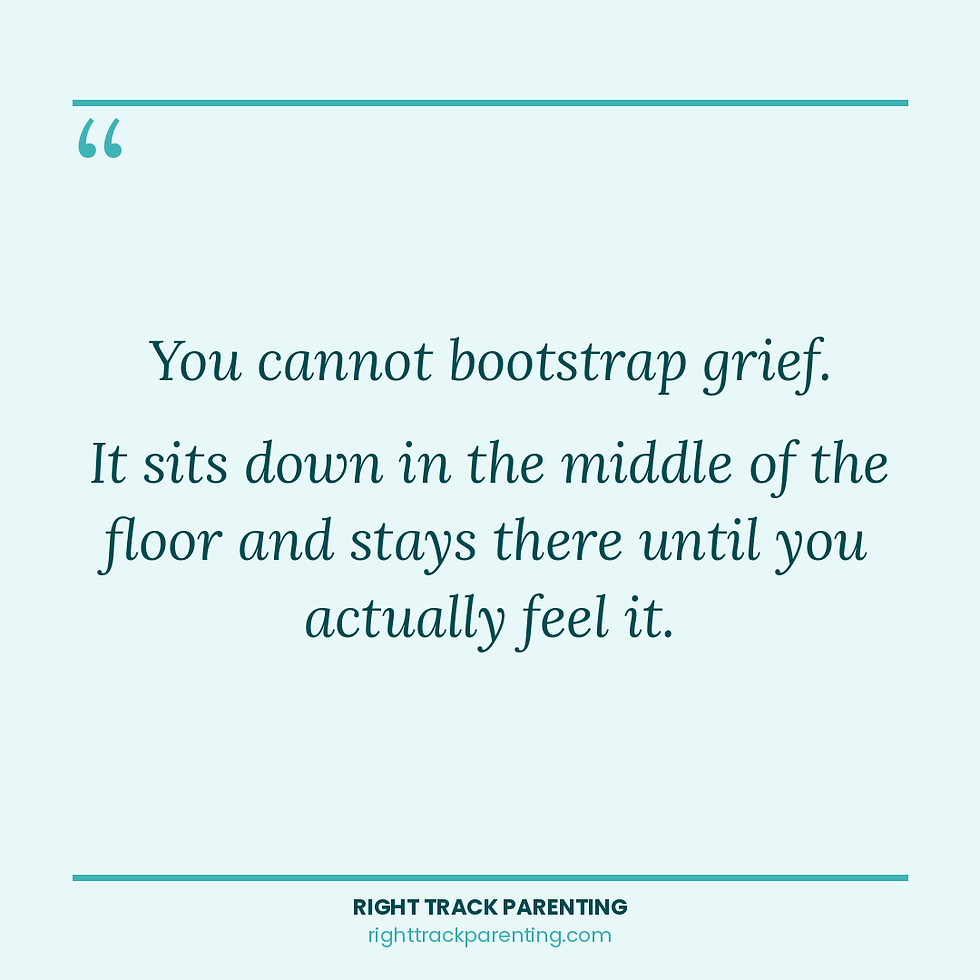
It was my second-husband Chip's illness that finally broke through. Three and a half years of watching someone I loved decline, and then losing him — in room 15 at Inova's emergency department, on a May night in 2020 — did something permanent to me. You cannot bootstrap grief. It does not respond to German efficiency. It sits down in the middle of the floor and it stays there until you actually feel it.
What Chip's death gave me — unexpectedly, devastatingly, and ultimately as a gift — was the absolute certainty that tomorrow is not promised. And knowing that, I could no longer afford to carry what wasn't mine. I could no longer hand my daughters rocks and call it love.
What the Science Knows
Here is something biology has quietly confirmed about mothers and daughters: when you carry a child, some of their cells cross the placenta and take up permanent residence in your body. In your heart. Your lungs. Your brain. Research has detected these fetal cells — fetal microchimerism, meaning simply a small population of cells from one individual living inside another — in mothers up to 27 years after delivery.
Twenty-seven years. Your daughter is still inside you, at the cellular level, long after she's grown and moved to Paris or Vietnam or James Madison University.
And it goes both ways. During pregnancy, some of your cells cross into your child as well. You are inside her too.
I find this almost unbearably beautiful. It means the question is not whether we are connected to our daughters — we are, right down to the cellular level, in ways we're only beginning to understand. The question is only what we're sending. The cells travel whether we choose them to or not. What we choose is what travels with them.

The Clock Is Real
By the time a child turns 12, parents have spent approximately 75% of the in-home time they will ever have with that child. By 18, it's closer to 90%.
Sit with that for a moment.
I'm not offering this as a reason to panic. Panic is just another boulder, and we have enough of those. I'm offering it as clarity. The window for passing a wreath instead of a rock is real, and it is not infinite, and it is open right now.
The Investigative Parenting question worth asking — the Wonder Before You Worry version — is not what have I already handed my daughter? That question belongs to the past. The question that lives in the present, the one with power in it, is: what am I handing her today?

Stella. Calli. Eva.
When I sent my daughters the reel, Stella — who is nineteen, and who has, by the grace of years and hard-won growth, received fewer rocks from me than her older sisters did — responded immediately: So important!!!
She is right. And her quickness to see it tells me something about what it means to be handed fewer rocks from the beginning. She could recognize the wreath because she'd already felt it on her head.
Calli, my firstborn, my Paris girl, responded with three heart emojis. And I wrote back to her what I want every daughter who is reading this to hear from her mother:
You, being my first, were given rocks — intentionally plural — because I didn't know any better. Now I do. I hope you've learned to put them down. I know you won't hand them to your daughter. Every day, I'm putting a wreath of flowers on your head in my mind.
She said: Aw, love you. You're the best mom.
I told her she was the best first baby in the whole wide world.
Eva is teaching English in Vietnam right now. I'm not sure she's seen the reel yet. But she will. And when she does, she'll know the same thing is true for her.
Here is what I have learned about repair: it does not require a ceremony. It does not require the right words said at the right moment with the right lighting. It requires only the willingness to name the rock, set it down, and reach for something softer.

The Wreath
You don't have to know how the woman in the video knew. You don't have to have read the research or taken the course or gone to therapy or lost someone you loved in room 15 of an emergency department. You only have to notice — truly notice — the weight of what you're holding.
And then ask yourself: is this mine? Or was it handed to me by someone who loved me and didn't know any other way?

Because here is what a boulder wrapped in a virtue actually is: it is love doing the best it could with what it had. Your great-grandmother was not wrong to endure. Your grandmother was not wrong to stay. Your mother was not wrong to pull herself up. They carried what they were given in the only way they knew. The boulder is not a condemnation of the women who handed it down. It is simply an inheritance — and like any inheritance, you are allowed to keep what serves you and return what doesn't.
The terrifying question underneath every mother-daughter conflict is: if my daughter is different from me, what does that say about me?
It says you raised a woman brave enough to put it down.
That is the wreath. That is the whole thing.
About the Author
Cindi Z. Stevens Copeland, MA, CCC-SLP, is a speech-language pathologist with more than 30 years of experience working with children and families. She is the founder of Right Track Parenting and the creator of the Investigative Parenting methodology — a research-backed framework that guides parents to wonder before they worry, imagine before they interpret, and create before they catastrophize. Cindi holds a Certificate in the Foundations of Positive Psychology from the University of Pennsylvania and is a certified Parent Coach through the Parent Coaching Institute. She runs a direct-pay private practice in Northern Virginia and is the creator of LUMA, an AI-powered parenting assistant available at RaisingHumans.ai (coming soon!). Learn more about Cindi and Right Track Parenting at righttrackparenting.com.
© 2026 Right Track Parenting. All rights reserved. No part of this blog may be reproduced or distributed without written permission.


Comments