
You Never Stop Carrying Them
- righttrackparentin
- May 19
- 8 min read
A belated Mother's Day reflection on sons, separation, and the love that stays
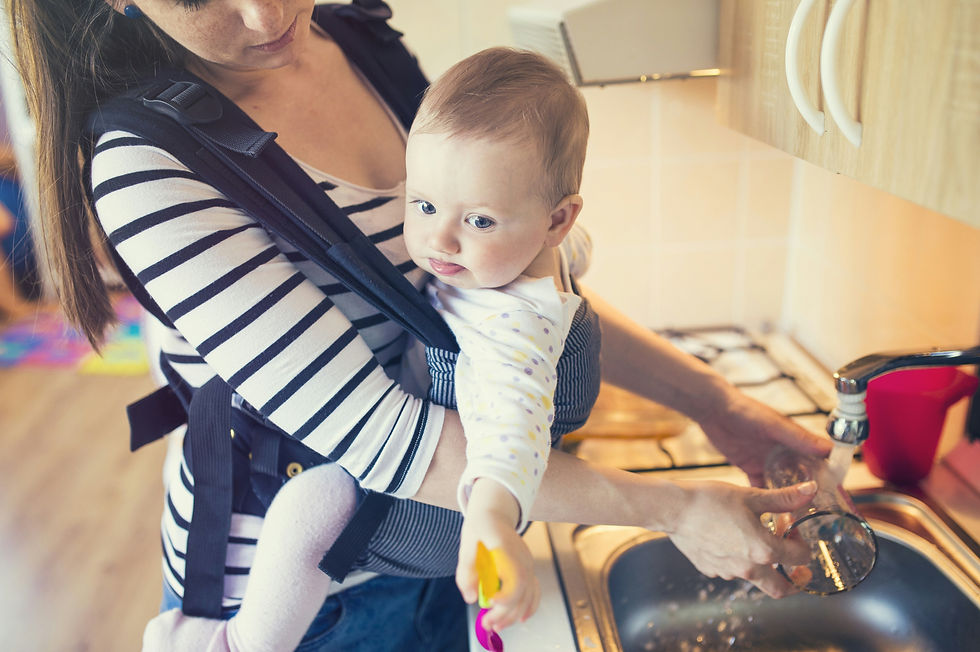
There is a particular kind of love that begins in the body.
Not the idea of love, not the promise of it — the actual, physical, gravitational fact of it. Nine months beneath your heart. The weight of him in your arms. The particular way a newborn finds your shoulder and exhales, as if he has finally arrived somewhere safe.
My son Michael was born fifteen and a half months after his sister Calli. I was already in motion — chasing a toddler, managing the beautiful chaos of a house with two children under two — and so I did what mothers have done for centuries. I put him in a sling and wore him. My mother-in-law, Mary, used to laugh and call him my brooch. She wasn't wrong. He went everywhere I went, tucked against my chest, his small face appearing at the opening of the sling every so often — curious, content, entirely certain that wherever I was, was exactly where he needed to be.
I didn't know then that I was storing something up. That the weight of him against my body was a kind of knowing I would carry long after he grew too big for the sling, too old for my shoulder, too much his own person to need me the way he once did.
I just knew that he was mine, and I was his, and for a little while, we were everything to each other.
What a Son Carries
My younger son, Sam, came into the world four children later — the fifth and last, our caboose. From the beginning, he was a baby who wanted to be held. Not because he was fussy or frightened, but because closeness was simply his nature. He nursed. He snuggled. He was, like Michael before him, a boy who understood that his mother was home.

When Sam was two months old, I took him in for his eight-week immunizations. He had a virus, so his pediatrician asked me to come back in two weeks. Over the days that followed, something strange began happening. Bruises were appearing on his tiny body — not from falls, not from bumps, but from nowhere. From nothing. They were appearing, in fact, right under his pediatrician's fingertips during his follow-up visit, gentle pressure producing purple blooms on skin that should have been unmarked.
His pediatrician sent us directly to the Department of Hematology and Oncology at Children's Hospital of The King's Daughters in Norfolk, VA, where we lived at the time. She told me they'd be waiting.
That began one of the longest journeys of my life.
Sam was diagnosed with an autoimmune disease attacking his platelets. They treated him with medicine. In July, his eyes turned yellow. His doctors diagnosed him with autoimmune hepatitis — his immune system, apparently unsatisfied with one target, had shifted to attacking his liver. This was rare in infants. Autoimmune hepatitis typically presents in children aged ten to fourteen. Sam was six months old.
More medicine. More watching. Slow, frightening decline.
By September, he was hospitalized. I never left his side. He was still nursing, still mostly breastfed, and had never been away from me for more than the few hours I saw speech therapy clients during the day. The doctors worked. They treated. They adjusted. They could not find the answer.
And then my mother mentioned a woman from her quilt guild — Mrs. Holder — whose daughter I had gone to high school with, who was now a neurologist at Children's Hospital of Pittsburgh. Mrs. Holder asked her daughter Debbie to share Sam's liver biopsy with the GI team there. Debbie did it that day.
The GI doctor who received it was Dr. Ben Schneider. And Dr. Schneider asked a question that the other doctors, in their urgency to treat, had not paused long enough to ask:
Why is this happening to this infant?
He went to the medical journals. He searched until he found it — five cases, documented in a British medical journal, of infants whose immune systems had attacked their red blood cells and then morphed into attacking their livers. Those infants had been treated with a medication called Rituximab. Those infants had gotten better.
The decision was made to transfer Sam to Pittsburgh. They would fly him by medical jet. There would be a pilot, doctors, nurses, medics — nine people, a full plane. They told me to drive to Pittsburgh and meet him there.
I told them to put me on the plane.
They explained again that the jet was full. That there was no room. That I should drive and he would be well cared for.
I explained that my son was a breastfed baby who had not been separated from me for more than a few hours, that he needed me more than he needed a third nurse, and that they were going to remove someone from that plane to make room for his mother.
They did.

We flew together from Norfolk. A month of Fridays in Pittsburgh followed — one Rituximab treatment per week. And slowly, steadily, Sam got better. By age eight, he was off all medications. Today, you would never know he was sick a day in his life.
But I know. I will always know. Because carrying your child isn't only the sweet weight of him in a sling on a Tuesday morning. It is also the fierce, irrational, immovable certainty that you are not getting off that plane.
The Seam That Rips
The author Ariel Lawhon wrote something recently that stopped me mid-scroll. She was writing about sons — about the particular love between a mother and a boy — and she said it this way:
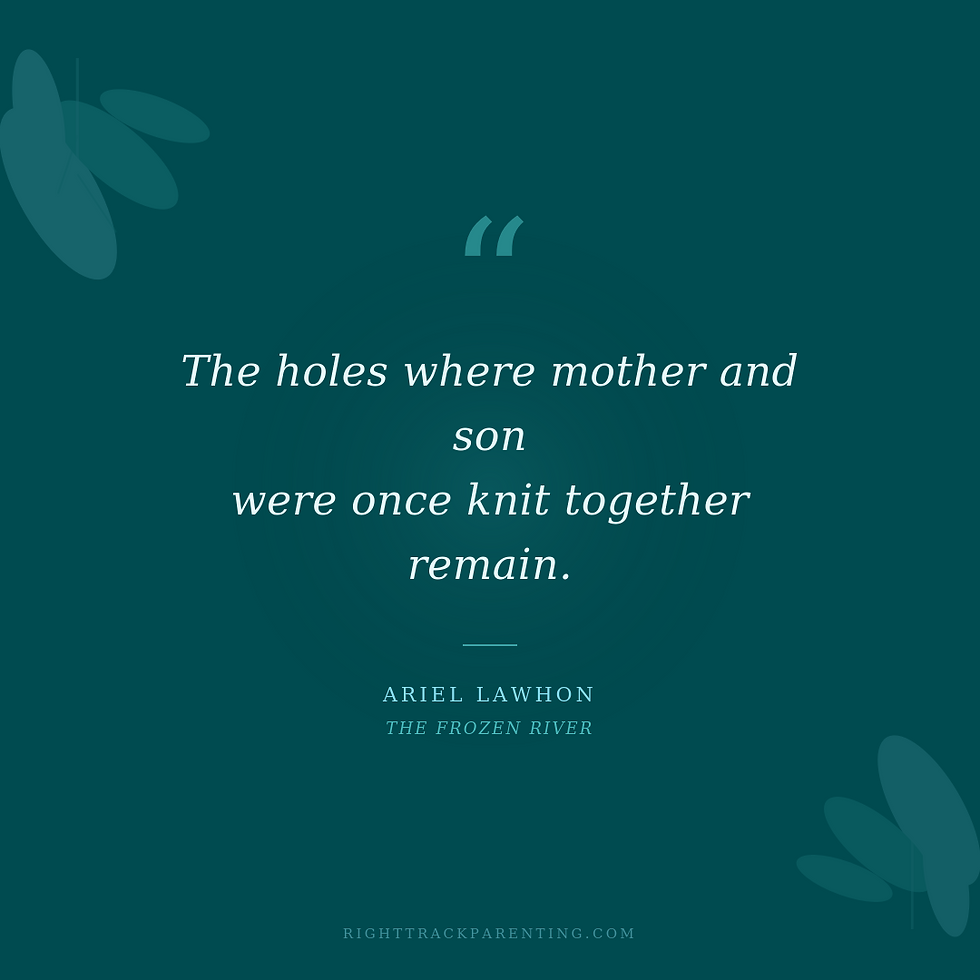
"The joy of having sons is that they worship their mothers. Until one day, suddenly, they don't. I am not like you, he realizes. We are different. Then, that boy — once small and sweet — begins the long, hard process of separation, until at last he rips the seam. But the holes where mother and son were once knit together remain."
I read it and felt recognized in a way I hadn't expected.
Because here is what I know about raising sons, after twenty-nine years of doing it: the separation doesn't sneak up on you gently. It announces itself. Sometimes loudly. Sometimes in the front yard.
Michael was a senior in high school. We were disagreeing about something — I no longer remember the specific content, only the temperature of it, the friction of two people who love each other and are currently furious with each other. I followed him outside, still talking. Loudly. He turned and looked me directly in the eye.
"My brain is changing," he said.
Not as an excuse. Not as a deflection. As information. As a boy trying to tell his mother something true about himself, even in the middle of a fight: I am becoming someone who is not defined by you. I am becoming myself. And that requires me to pull away from you, even though — maybe especially because — I love you.
I didn't let the disrespect slide. He was still living in my house and I still got to call certain shots. I told him so.
But his words stayed with me long after the argument dissolved. Because he was right. His brain was changing. He was individuating — that clinical word that means he was ripping the seam, becoming himself, putting me on the other side of a line so he could stand on his own.

Lawhon writes about this with such precision. The sociologist Nancy Chodorow argued decades ago that boys don't just separate from their mothers to grow up. They separate to become male. The distance isn't incidental — it's structural. He has to put you on the other side of the line in order to stand on his.
Which means the grief is real. And it is also right.
The Boys Who Still Show Up
This May has been, as every May is for me, a month of reflection.
My husband Chip died on May 31, 2020. Every year when May 1st arrives, something in me shifts into a quieter register — more porous, more prone to noticing things, more willing to sit with what I usually keep moving past. The anniversaries of loss have a way of making you honest.
This Mother's Day, something made me smile through the ache of it.
My daughters — my wanderers, my girls who from the time they could walk always wanted to be put down, always wanted to go — were scattered across the world. Calli was in Paris. Eva was in Vietnam. Stella was at JMU in the middle of final exams. And on Mother's Day, she spent the day with her boyfriend’s mother who came for a visit.
His mother. She spent the day honoring his mother on Mother's Day.
I laughed when I thought about it. Because of course she did.
My boys, though? My boys showed up. Michael and his wife Karen came. Sam was, of course, present and accounted for. There were hugs — the real kind, the kind that come from young men who still know how to give them. The seam ripped long ago. The holes remain. And they still showed up.
I have thought about this a lot since — about why Michael found Karen, about why Sam, at 16-and-a-half, has had the same girlfriend since the summer before eighth grade. I think they went looking for someone who knew how to love them the way I did. Not because they needed a replacement, but because closeness was their first language. I taught it to them.
They didn't forget it.
What Gets Entrusted

There is a Buddhist teaching that has been sitting with me this month. It goes something like this: the love someone had for you was not destroyed when they left. It was entrusted to you.
I find myself applying that not only to Chip — though it belongs to him too — but to the early years with my boys. That fierce, consuming, worship-level love that Michael had for me when he was small, when I was his entire world, when he poked his face out of the sling just to find me? It didn't disappear when he individuated. When his brain changed. When he married Karen.
It was entrusted to her.

And Sam's love — the love of a baby who held on through illness, who flew with his mother across three states, who got better across four Fridays and years and a doctor who stopped long enough to ask the right question — that love is alive and well in the young man who put his arms around me on Mother's Day.
No matter how tall they grow or how far they go, you never stop carrying them.
And if you did it right — if you loved them well, held them close, got on the plane, stood in the front yard, let them go when it was time — they never stop carrying you, either.

About the Author
Cindi Z. Stevens Copeland, MA, CCC-SLP, is a speech-language pathologist with more than 30 years of experience working with children and families. She is the founder of Right Track Parenting and the creator of the Investigative Parenting methodology — a research-backed framework that guides parents to wonder before they worry, imagine before they interpret, and create before they catastrophize. Cindi holds a Certificate in the Foundations of Positive Psychology from the University of Pennsylvania and is a certified Parent Coach through the Parent Coaching Institute. She runs a direct-pay private practice in Northern Virginia and is the creator of LUMA, an AI-powered parenting assistant available at RaisingHumans.ai (coming soon!). Learn more about Cindi and Right Track Parenting at righttrackparenting.com.
© 2026 Right Track Parenting. All rights reserved. No part of this blog may be reproduced or distributed without written permission.


Comments